
From “save first, spend later” to “experience first, explain later” – the financial philosophy that built modern India is crumbling under the weight of social media, easy credit, and a fundamentally different relationship with money. Walk into any Indian household today and you’ll witness a quiet financial revolution. The grandmother who saved every paisa in steel boxes, the father who viewed debt as moral failure, and the daughter who casually orders ₹3,000 worth of Korean skincare products on a BNPL app – three generations, three completely different money universes. India’s household savings rate has plummeted from 34.6% of GDP in 2011-12 to just 29.7% by 2022-23 – a four-decade low that signals cultural transformation.
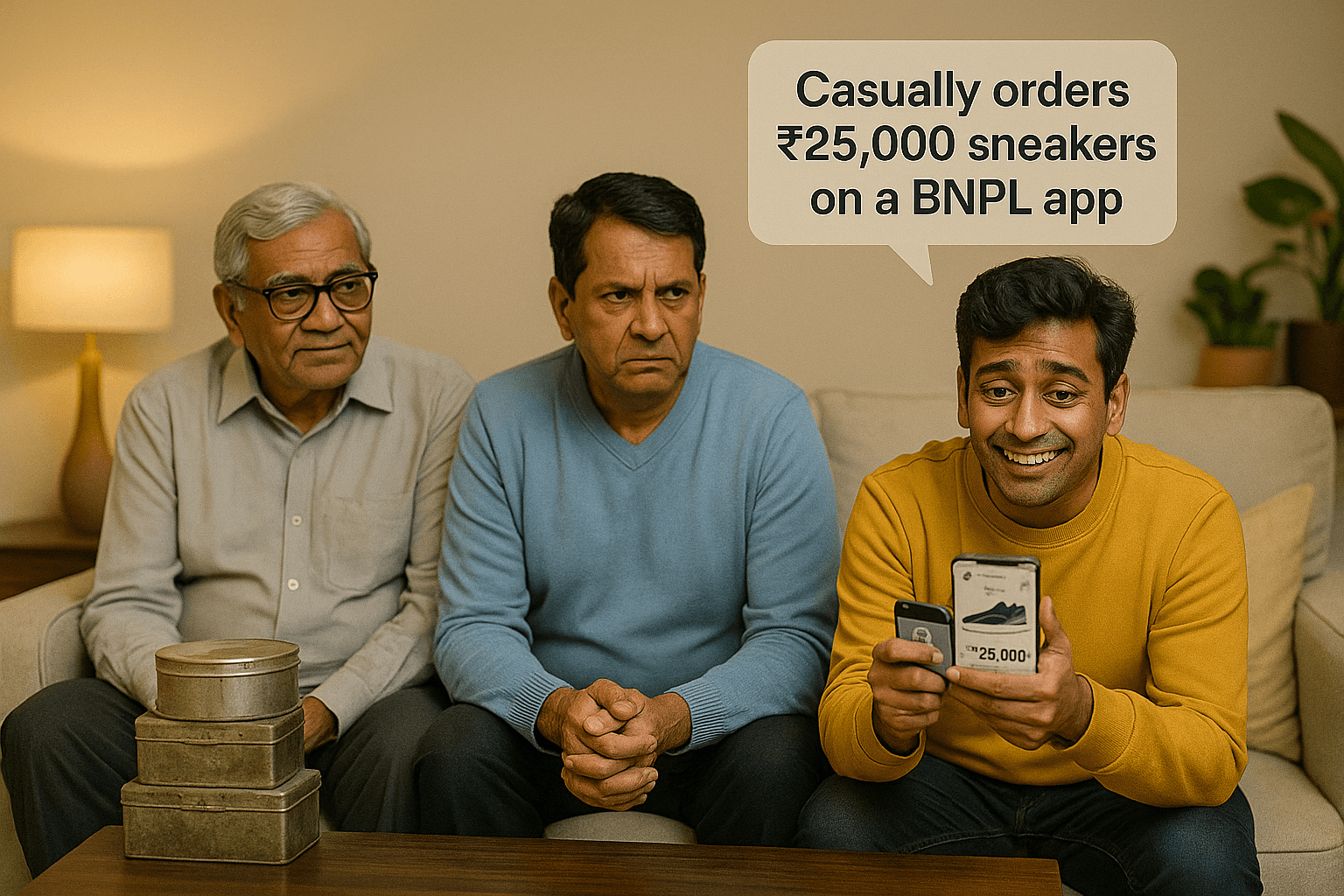
The Cultural Philosophy Flip For centuries, Indian families operated on a simple principle: save first, spend what remains. Parents demonstrated restraint daily, treating money as something that needed careful protection for future generations. Today’s young Indians have completely flipped this. Gen Z’s philosophy: “experience first, explanation later”. While their parents saved first and spent later, millennials tried balancing SIPs with EMIs. But Gen Z refuses to postpone life. The numbers are stark. Only 50% of young Indians could save anything in 2025, down from 60% in 2024. Despite earning average monthly incomes of ₹33,000, the traditional ‘surplus mindset’ has evaporated. Unlike their parents who compared themselves to neighbors, today’s youth measure their lives against curated global content – Korean ramen, premium cafés, Stanley cups, Ed Sheeran concerts.
The Debt Revolution and Social Media Trap The most shocking departure? The normalization of debt as lifestyle funding. Previous generations viewed borrowing money for consumption as failure and shame. Today’s reality: Millennials carry the highest bad debt ratio at 35% across all generations. Credit card dues have ballooned to ₹2.7 trillion, with 99 million consumers opening their first credit product in 2023-24. 48% of first-time borrowers open a second credit product within a year. 60% of young India’s purchase decisions are influenced by short videos and social media. 40.5% make impulse purchases after seeing products on social media. The combination of smartphone addiction, social media dependency, and FOMO creates a perfect storm of financial destruction.
The Stress Epidemic and the Path Forward This behavioral revolution comes with unprecedented psychological cost. 80% of Indian employees faced mental health issues in the past year, with financial stress as the leading cause. The statistics are alarming: • 55% of Gen Z live paycheck to paycheck • Only 31% of Gen Z feel financially secure • 69% rate their financial situation as only “fair” or worse Paradoxically, this generation is more financially sophisticated than any before them. 93% of Gen Z save regularly, putting away 20-30% of their income. 35% began investing before age 25. Yet they’re simultaneously more investment-savvy and more financially stressed. The most financially successful young Indians aren’t the highest savers or biggest spenders – they’re those who’ve developed “intentional financial behavior”. They save meaningfully, invest wisely, and spend purposefully without guilt or anxiety. The question isn’t whether India’s saving culture is dying – it’s whether the new generation can build something better from its ashes. The financial stress epidemic among young Indians isn’t inevitable. It’s the growing pains of a generation navigating economic complexity their predecessors never faced, armed with tools and opportunities their grandparents never imagined. The challenge now is learning to use this power wisely, before the psychological costs become irreversible.